Have you ever looked at the starting price for a new car and known instinctively that the price on the sticker isn’t the price you’ll actually pay? Buying a modular home can feel surprisingly similar. That attractive “standard” price is a starting point, and understanding the prefabricated home standard inclusions is the key to creating a realistic budget and avoiding surprises.
First, it’s crucial to clear up the most common point of confusion in the modular vs. manufactured home debate. A modular home is built in sections inside a factory to the exact same local and state building codes as a traditional, site-built house. In contrast, a manufactured home (what many still call a mobile home) is built to a single, national code from the U.S. Department of Housing and Urban Development (HUD).
This distinction in building codes changes everything for a homeowner. Because a modular home meets all local construction standards, it is placed on a permanent modular home foundation and becomes legally recognized as real estate. In practice, this means it finances, appraises, and holds its value just like any other house in the neighborhood, making it a solid long-term investment.
The “Standard” Factory Package: What’s Usually Inside the Box?
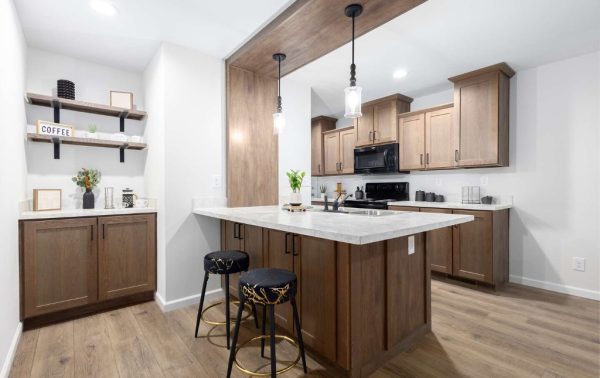
When you review a modular home floor plan, the listed price typically covers the standard factory package. This is the collection of basic interior finishes the factory will install before shipping the home. It includes all the essentials, from the paint on the walls to the cabinets in the kitchen, that make the house functional from day one.
These standard items are often described as builder grade. This isn’t a negative term; it simply means the materials are chosen for their durability and value, rather than for luxury. They are functional, meet all building codes, and help keep the base price of the home affordable. For example, builder grade is the sturdy laminate countertop, not the premium, high-end quartz you might see in a design magazine.
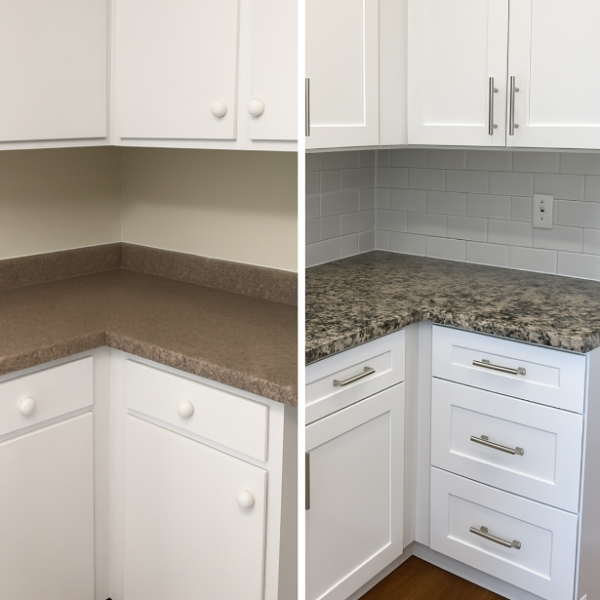
Understanding the difference is key to managing your budget. Manufacturers provide a “spec sheet” that lists these defaults and the available upgrades. Here’s a typical comparison:
- Standard (Builder Grade): Vinyl sheet flooring, laminate countertops, basic chrome faucets.
- Upgrade: Luxury vinyl plank flooring, granite countertops, designer bronze faucets.
Finally, always ask what’s not included in the standard price. Many homebuyers are surprised to find that major appliances like the refrigerator, washer, and dryer are often considered separate purchases. With a clearer picture of what’s inside the home modules, the next step is figuring out how they get from the factory to your property.
The “Delivery & Set” Question: Is Getting the Home to Your Land Included?
Once your home’s modules are built, they have to get to your land. This step introduces one of the biggest potential hidden costs: the delivery fee. Transporting sections of a house requires special trucks and permits, and many retailers treat this as a separate line item, not part of the standard price. The farther the factory is from your property, the higher this fee will be, often adding thousands to your budget before a single piece has been touched.
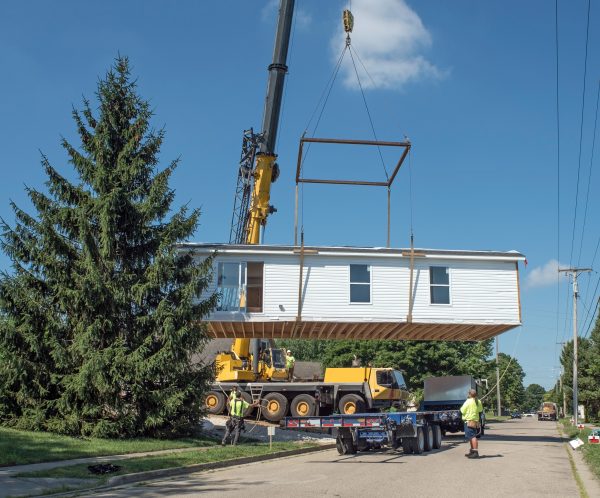
Getting the home to your property is only half the battle. They then need to be lifted and placed onto the foundation. This isn’t a simple job; it requires a massive crane and a specialized set crew to guide each piece into place with precision. This critical step, known as “setting the home,” is another significant expense that may or may not be bundled into the “standard” price you were quoted by the retailer.
This is where comparing quotes can get tricky. A quote of $180,000 that includes delivery and the set crew is a better deal than a competitor’s $172,000 quote that doesn’t. That seemingly cheaper price could hide $10,000 or more in transportation and crane fees. So, before you compare any numbers, get a clear answer to the question: “Does your price include delivery and the set?” With the house now on the foundation, you still have to tackle all the work on the land itself.
At InfinityBilt Homes, we take care of those heavy lifts like foundation, delivery, and set when most other companies will leave you the remaining work, making you ask “now what do I do?”. Our difference: we don’t guide our customers, we take care of our customers. Each home, before delivery, will have a foundation. During the setup, we take care of setting, craining, and finishing. No need to figure it out yourself, that’s our promise.
Site Work: The Big Costs That Are Never in the “Standard” Factory Price
With the house now resting on its foundation, it might look like you’re in the home stretch. However, the most significant expenses are often the ones that happen entirely on your land. The retailer’s “standard” price almost never includes the cost to prepare your property and connect your house to the outside world. This is where many buyers are surprised by how much is left in their budget to finish the job.
This collection of on-site jobs is called site work, and it’s managed by a local builder, not the factory. Think of it as everything needed to turn a raw piece of land into a fully functional homesite. While every project is different, site work almost always includes:
- Clearing and grading the land
- Pouring the concrete foundation
- Running utility lines (water, sewer, and electricity)
- Installing a septic system or well if needed
- Building a driveway, walkways, porches, or a garage
So who manages all this? This is usually the job of the cusomer’s General Contractor (GC). A GC is your local project manager who hires the excavators, electricians, and plumbers needed to complete all the site work. They are responsible for getting the permits and ensuring everything is built to local code. Many other companies will require you have a separate contract with your GC for this work.
Because these on-site costs can be so significant, InfinityBilt Homes offers turnkey pricing. This is an all-in-one price that includes not just the factory-built home and its delivery, but all the necessary site work as well. A turnkey price aims to give you a true, move-in-ready cost, making it far easier to budget than a simple factory base price.
How to Compare Apples to Apples: Why Base Prices Can Be Deciving
Imagine you receive two quotes for the exact same floor plan. Company A quotes you $175,000, while Company B comes in at $195,000. The cheaper option seems like a no-brainer, but this is where many buyers make a costly mistake. The initial price tag rarely tells the whole story, and the lowest number isn’t always the best deal.

Digging into the details, you might find that Company A’s price doesn’t include delivery or the crane needed to set the home. It might also be based on their most basic standard finishes, like laminate counters and vinyl flooring. In contrast, the higher quote from Company B could include delivery, the crane crew, and the quartz countertops and hardwood floors you actually wanted. Suddenly, that $20,000 cost difference between the two proposals makes perfect sense.
“InfinityBilt Homes offers turnkey pricing which gives you a true, move-in-ready price and takes the work off your shoulders.“
This is precisely why you can’t compare final numbers alone. The only way to get a true apples-to-apples comparison is to ask each builder to provide a detailed breakdown of their offer. You need to see the separate costs for the factory-built modules, for the delivery and set, and for the site work and finishings. By comparing these individual components, you’ll uncover the real value and make a decision with confidence, avoiding expensive surprises down the road.
Your Ultimate Checklist: 10 Questions to Ask Before You Sign Anything
Knowing that base prices can be misleading is one thing; getting the real details from a builder is another. To cut through the sales pitch and protect your budget, you need to be in the driver’s seat. Arm yourself with this checklist, it will empower you to lead the conversation and get the specific answers you need to truly compare offers.
Before you get serious about any proposal, ask the builder these questions and request the answers in writing.
- Is this price for the house only, or is it a turnkey (move-in ready) estimate?
- Does the price include delivery fees and the cost of the crane/set crew?
- Can I see a detailed specifications sheet with the brand and model of standard windows, doors, and siding?
- Are kitchen appliances included? If so, which specific ones?
- What are the “standard” materials for flooring, countertops, and cabinets?
- What is your allowance for site work? What happens if costs go over budget?
- Who is responsible for securing and paying for all necessary building permits?
- What warranties are included for the structure and the materials?
- What are the most common upgrades for this model and their exact costs?
- Can you provide a list of common exclusions or items I will be responsible for?
The answers you receive are incredibly revealing. A trustworthy partner will readily provide a detailed “spec sheet” and be transparent about allowances, which are simply budget estimates for variable costs like excavation. If a builder is vague, brushes off a question, or says “we’ll figure that out later,” that’s a major red flag. Getting these details on paper is the only way to confidently know what you’re paying for.
The “Standard” Price is Your Starting Line, Not the Finish Line
That initial ‘standard’ price for a modular home no longer has to be a source of confusion. Where you once saw a single, misleading number, you can now see the full picture. Like a car’s base price, you understand it’s the starting line, not the finish line, for a process that includes essential features and ‘on-the-road’ costs.
This new clarity is your most powerful tool for creating a realistic modular home budget. By knowing to ask about the three core areas: the factory build, the delivery and set, and the on-site finishing work, you can transform confusing quotes into a clear, apples-to-apples comparison. This framework is the key to understanding modular pricing and preventing budget overruns.
You are no longer just a spectator in the process of buying a modular home; you are an informed participant. You now have the framework and the questions to navigate your journey with confidence, ensuring the price you agree to is the price you can count on.
The InfinityBilt Difference
At InfinityBilt Homes, we don’t believe in teaser pricing or surprise add-ons after you’ve committed. When we present a quote, it reflects the full scope of what we’ve discussed, clearly outlined and fully explained. No hidden transportation fees. No last-minute crane charges. No vague allowances that suddenly balloon.
We take the time upfront to review specifications, delivery, set, and coordination so you understand exactly what’s included. The number you agree to is the number you can plan around.
In an industry where base prices are often used as marketing tools, we focus on transparency. Our goal isn’t to offer the lowest starting number, it’s to give you a clear, realistic path to ownership with confidence from day one.